


IE2 vs IE3 Electric Motors: Efficiency, Energy Savings and Payback

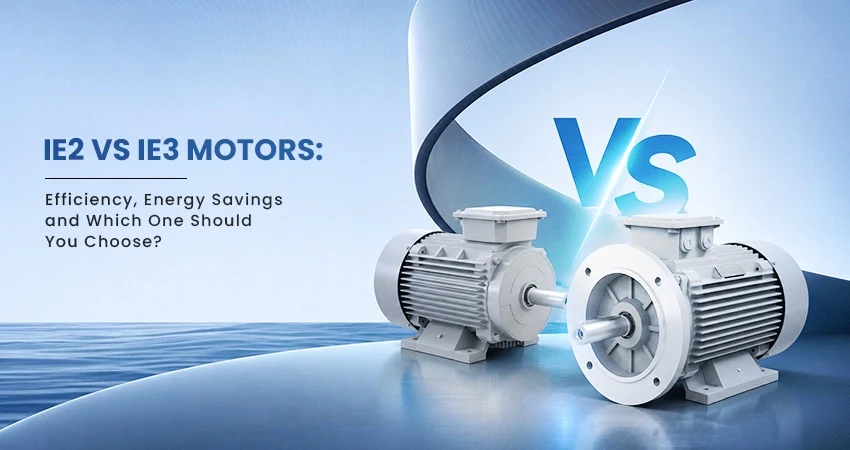
Two motors can look almost the same on paper and still cost very different amounts to run. The difference lies in how much electricity each one wastes as heat, and that waste gets expensive when a motor runs all day.
Choosing between IE2 and IE3 for your electric motors comes down to three simple things: how many hours the motor runs, what electricity costs you, and how much more the efficient option costs to buy.
What Do IE2 and IE3 Actually Mean?
According to UNIDO, electric motor systems account for about 60 per cent of global industrial electricity consumption and close to 70 per cent of industrial electricity demand, so even a small gain in efficiency adds up.
IE stands for International Efficiency, and its classes are defined in IEC 60034-30-1. IE2 is called High Efficiency and IE3 is called Premium Efficiency. This means IE3 turns a little more of the electricity it takes in into useful work. The class describes efficiency, not output. Two motors with the same rating deliver the same shaft power.
For a 7.5 kW, 4-pole, 50 Hz motor, IEC 60034-30-1 and IS 12615:2018 ask for at least 88.7 per cent efficiency at IE2 and 90.4 per cent at IE3. That gap is under two points, but it repeats every hour the motor runs.
How Much Can an IE3 Motor Save in a Year?
Let us assume a 7.5 kW motor that runs at full load for 6,000 hours a year, electricity at ₹8 per unit (kWh), and an IE3 option that costs an assumed ₹8,000 more. Real motors often run below full load, which reduces the saving, and the price gap will differ between makes and quotes.
On these numbers, the IE3 option saves about 950 units of electricity a year, which is roughly ₹7,600. The extra ₹8,000 is recovered in about 13 months. Payback is simply the extra price divided by the yearly saving, and running hours change it the most. At 4,000 hours a year the payback is about 1.6 years, and at 2,000 hours it is about three years.
For electric motors on a continuous shift pattern, an IE3 motor repays its extra cost quickly, while for a few hours a day an IE2 motor can be the better buy.
To see how this scales, picture a packaging unit that runs ten 7.5 kW, four-pole motors on fans and pumps across three shifts, each at full load for about 6,000 hours a year. Choosing IE3 instead of IE2 for all ten would save around 9,540 units of electricity annually. At an assumed ₹8 per unit, that is about ₹76,000 a year. If the ten IE3 motors cost ₹80,000 more in total, the savings would cover that extra cost in about 13 months. This is an illustrative scenario and not a customer case, and real results depend on the load and running hours.
Is IE2 Still a Sensible Choice Today?
Yes, in the right place. An IE2 motor is not outdated, and it suits motors that run only a few hours a day. In India, IS 12615:2018 is the standard for three-phase motors and covers the IE2, IE3 and IE4 classes, so IE2 remains a recognised class here. BIS certification under IS 12615 has been mandatory since 1 October 2017, according to the BIS circular. The EU is stricter. Commission Regulation (EU) 2019/1781 has set tougher limits since 2021 and requires IE4 for 2, 4 and 6 pole three-phase motors of 75 to 200 kW from 1 July 2023.
How Do You Choose Between IE2 and IE3 for Electric Motors?
- Find the real load and hours: Note the yearly running hours and the load.
- Get both quotes: Work out the IE2 and IE3 price difference.
- Run the payback formula: Use your tariff, or the energy audit page.
Energy efficient products matter most where a lot of energy is used.
LEDL’s IE2 and IE3 Ranges
We manufacture 3-phase electric motors from 0.12 kW to 110 kW in 2, 4, 6 and 8 pole configurations, across two ISO 9001:2015 certified factories, with Coimbatore as our registered address. Our induction motors come in IE2 and IE3 classes, while our IE5 motors are synchronous reluctance motors, listed on our IE5 page, with IE4 available on request. Browse the shop or contact our team to match a motor to your load.
FAQs
What is the difference between IE2 and IE3 efficiency?
IE2 is the High Efficiency class and IE3 is the Premium Efficiency class under IEC 60034-30-1. IE3 wastes a little less energy as heat for the same work, so it costs less to run. The gap looks small on paper, but it repeats every hour the motor runs. The class affects only how much energy is wasted and not the power the motor delivers.
How long does it take to recover the extra cost of a more efficient motor?
Divide the extra price of the efficient motor by the money it saves in a year. In our example, with an assumed ₹8,000 extra and ₹8 per unit, that is about 13 months at 6,000 hours and about three years at 2,000 hours. Your own result will differ, so use your real quotes and electricity bill. LEDL’s energy audit page can also compare old and new motors for you.
Why might a business still choose IE2?
If your payback limit is shorter than about three years, IE2 may be the better buy for a motor that runs around 2,000 hours a year, since the extra cost of IE3 takes about three years to repay at that level of use. In that case the money saved on purchase can be used elsewhere in the plant. IE2 can also suit standby or seasonal equipment that runs only now and then. The choice should rest on a payback check with your own hours and tariff.
Which electric motors suit continuous heavy-load use?
Motors that run thousands of hours a year close to their rated load gain the most from a higher class, because a small saving every hour adds up. In our example, the IE3 option repays its extra cost in about 13 months at 6,000 hours. It is also worth checking that the motor is the right size, since a motor running well below its rating wastes some of the benefit.
How do energy efficient products differ from IE1 Standard Efficiency motors?
IE1 is the Standard Efficiency class and sits below IE2 on the IEC scale. In India, IS 12615:2018 recognises the IE2, IE3 and IE4 classes, so the efficient motors are those from IE2 upwards, which lose less energy as heat for the same useful output. That means a smaller electricity bill over the life of the motor, although the purchase price is usually a little higher. Compare the rated efficiency of the exact models before you decide.
Sources: UNIDO; IEC 60034-30-1:2025, Efficiency classes of line operated AC motors (IEC, December 2025); Commission Regulation (EU) 2019/1781, EUR-Lex; Circular on implementation of IS 12615:2018, Three Phase Squirrel Cage Induction Motors (Bureau of Indian Standards, ETD 15/IS 12615, 10 January 2019); LEDL About page; LEDL Energy Audit page
Explore our latest Blogs
Everything You Need to Know About Choosing the Right Induction Motor for Heavy Machinery
Why UL Certified IE3 Motors Matter for Energy-Efficient Industrial Operations
Why Synchronous Reluctance Motors Are the Future of Energy Efficient Industrial Operations
Energy Efficiency Is No Longer Optional for Modern Manufacturing Plants
