



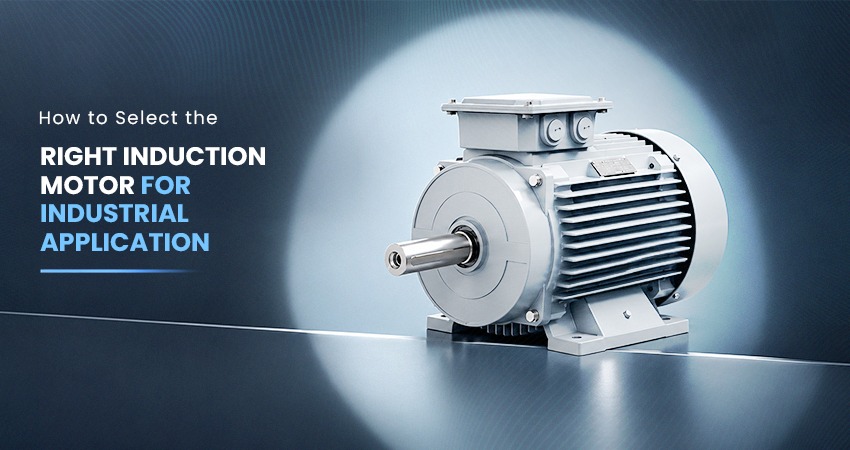
How to Select the Right Induction Motor for Industrial Application

A bigger motor often seems like the safe choice when you place an order, but if it runs at less than half load for years, you end up paying for it in higher electricity bills.
Nine details determine whether an induction motor suits the machine it will drive, ranging from supply and speed to mounting and efficiency. Power rating is only the first, and most of the others are printed on the nameplate, making it easy to compare one supplier with another.
What Should You Check Before Choosing an Induction Motor?
Each detail below comes with a note on what can go wrong if you miss it:
- Power rating: This tells you how much work the motor can do, shown in kW or HP. Indian catalogues, including LEDL’s, list kW first, and a rating that is too low or too high wastes money.
- Supply voltage and frequency: Industrial three-phase motors in India typically run on 415 V and 50 Hz, so if the nameplate does not match your supply, the motor can overheat or fail to start.
- Speed and pole count: The number of poles decides how fast the shaft turns, and the next section explains how this works.
- Duty type: This describes how the motor is meant to run (IEC 60034-1). S1 is continuous running at a steady load, while S3 is intermittent periodic duty, a repeating cycle of running and rest periods, so a motor rated for one may not suit the other.
- Enclosure protection: The IP rating shows how well the body keeps out dust and water. IP55 is a common choice in dusty or splash-prone areas, as it protects against dust and low-pressure water jets.
- Frame size: The frame decides the shaft height and the bolt positions, so a motor with a different frame will not line up with your existing base or coupling.
- Starting method: A motor draws several times its running current at startup. Direct-on-line connects it straight to the supply, which is simple and works well for small motors, while star-delta starters or a variable speed drive make starting gentler for larger ones.
- Mounting type: This is the way the motor is fixed in place, and it is covered below.
- Efficiency class: This shows how little energy the motor wastes as heat, and it is also covered below.
How Do Pole Count and Speed Work Together?
A motor with more poles runs slower. On a 50 Hz supply, a 2-pole motor turns at 3000 rpm, a 4-pole motor at 1500 rpm, a 6-pole motor at 1000 rpm and an 8-pole motor at 750 rpm.
These are synchronous speeds, the speed of the rotating field inside the motor. Under load, the shaft lags slightly behind that field, and this small gap is called slip. As a result, a 4-pole motor settles a little below 1500 rpm. Choose the pole count that gives the speed your pump, fan or gearbox needs. A 4-pole motor is a common choice for general drives, but it is worth confirming what your equipment requires.
Which Mounting Type Suits Your Machine?
IEC 60034-7 gives each way of fixing a motor its own code:
- IM B3: Foot-mounted, bolted to a base or frame.
- IM B5: Flange-mounted, bolted to the face of the driven equipment, such as a gearbox or pump.
- IM B35: Foot and flange together, so the same motor can be fixed either way.
Here is an illustrative case. Imagine a pump that has a flange face. A foot-mounted motor placed beside it may not connect to the pump shaft correctly, and the mistake may only come to light on installation day, when a B5 or B35 motor would have been the right order.
What Do the IE Efficiency Classes Mean?
The IE classes rank motors by how much energy they lose. IEC 60034-30-1 names the classes IE2 High Efficiency, IE3 Premium Efficiency, and IE4 Super Premium Efficiency; IE5, Ultra Premium Efficiency, sits above them. A higher class wastes less energy for the same work, so a higher-class induction motor tends to pay back the most when it runs many hours every day.
In India, IS 12615:2018 sets efficiency classes and performance rules for three-phase motors that run directly from the mains supply, and BIS certification has been mandatory since 1 October 2017. Our IE2 and IE3 pages list those classes, while the IE5 range uses a different motor type, which is covered at the end.
How Do You Decide Between a 1 HP Motor and a Larger One?
One HP is roughly 0.75 kW. A 1 HP induction motor is meant for light jobs such as small fans, light pumps and compact machines, but it works only if the measured load stays within that rating.
Sizing matters in both directions. A lightly loaded induction motor works at lower efficiency and a lower power factor, which shows how much of the current drawn does useful work. The US Department of Energy motor tip sheet says efficiency usually peaks near 75% of rated load, stays close to its full-load value at 50%, and falls sharply below about 50%. An undersized motor has the opposite problem: because it overloads, its windings overheat, and the insulation can fail early.
Here is an example. Say a conveyor needs 1.8 kW at the shaft:
- 1 HP (0.75 kW): This motor would be overloaded, so you can rule it out.
- 3 HP (roughly 2.2 kW): This puts the motor at about 82% load, which is a much more comfortable range for efficiency.
- 5 HP (around 3.7 kW): This leaves the motor running at only about 49% load, where efficiency and power factor can start to fall.
It is best to measure the real load first. If it falls between about 0.4 and 0.75 kW, a 1 HP induction motor is a reasonable fit. Below that, the motor would run at under half load, and above 0.75 kW it would be overloaded, so move up to the next rating that clears the load, with some room for starting. LEDL’s energy audit calculator shows what a higher-class motor could save. Enter the efficiency of your old and new motors along with your electricity tariff and the price of the new motor, and it gives the monthly saving and the payback period.
When Does a 3 HP Induction Motor Make Sense?
At roughly 2.2 kW, a 3 HP induction motor sits in the small-to-medium range. It handles larger pumps, compressors and machines with a steady load that is too heavy for a 1 HP unit.
Factor | 1 HP motor | 3 HP motor |
Approximate rating | 0.75 kW | 2.2 kW |
Typical use | Small fans, light pumps, compact machines | Larger pumps, compressors, small to medium industrial loads |
Load range for good efficiency (50 to 100% of rating) | 0.37 to 0.75 kW | 1.1 to 2.2 kW |
Load at best efficiency (about 75%) | 0.56 kW | 1.65 kW |
Motor Options From LEDL
Our work follows ESS®, which stands for Efficiency, Service and Safety. On efficiency, we help you size the right motor for the load and not only for the price, which is the same advice given above. On service, we aim to quote correctly and keep our promises, and our motors come with a warranty of up to five years. On safety, we ask for the correct application data before suggesting a motor, so that it runs safely on your machine. ESS® is a registered trademark of Lakshmi Electrical Drives Private Limited.
If you are weighing an LEDL motor against your current one, the shop lists our motors by rating and mounting, and you can contact our team for help in matching a motor to your machine.
FAQs
What is the difference between a 1 HP and a 3 HP motor?
A 1 HP motor gives roughly 0.75 kW of power, while a 3 HP motor gives roughly 2.2 kW. The 1 HP motor is meant for light work such as small fans and pumps, and the 3 HP motor can handle bigger pumps and compressors. For example, if your machine draws 1.8 kW, the 1 HP motor would be overloaded, but the 3 HP motor would work well.
What size of motor do I need for my machine?
Start by finding out how much power your machine actually uses, then pick the nearest motor rating above that number. A motor works best when it carries around 75% of its rating, although anything between 50% and 100% is fine. It also helps to leave a little room, because a motor pulls extra power for a moment when it starts. Remember to match the supply voltage, too.
Why does the efficiency class of an induction motor matter?
A higher class wastes less energy as heat, which saves more money when the motor works many hours every day. For a motor that is used only now and then, IE2 may be enough. When you speak to a supplier, it is a good idea to ask for the efficiency at your usual load and not just the class name.
Which mounting type suits a motor bolted directly to equipment?
A flange-mounted motor (IM B5) is made to bolt straight onto the equipment it drives, such as a pump or a gearbox. If the motor might also need to stand on a base, IM B35 lets you fix it either way. Make sure the flange size matches before you order, because a wrong match can hold up your work.
How do I choose an LEDL motor for my application?
Start with the power you need in kW, your supply voltage, and the speed you want, since speed tells you how many poles to choose. Then pick the mounting type and compare efficiency classes against how many hours the motor will work each day. Our range goes from 0.12 kW to 110 kW, and our team can help you check these details before you order.
Sources
Claim in the article | Source |
Efficiency peaks near 75% load, stays flat at 50%, falls below about 50%. Power factor drops at light load. | |
LEDL’s range is 0.12 to 110 kW, in 2, 4, 6 and 8 pole configurations, with two ISO 9001:2015 certified factories and a Coimbatore address. | |
LEDL has IE2, IE3 and IE5 category pages, a shop and an energy audit page. The IE5 product listed on the LEDL website is a synchronous reluctance motor (SynRM). | |
Synchronous speeds of 3000, 1500, 1000 and 750 rpm, with slip. | |
S1 is continuous duty and S3 is intermittent, under IEC 60034-1. | |
IP55 means dust protected and protected against water jets. | |
IS 12615:2018 is the Indian standard for line-operated three-phase motors. BIS certification became mandatory on 1 October 2017. |
