


Synchronous Reluctance Motors vs Induction Motors: What Is the Difference?

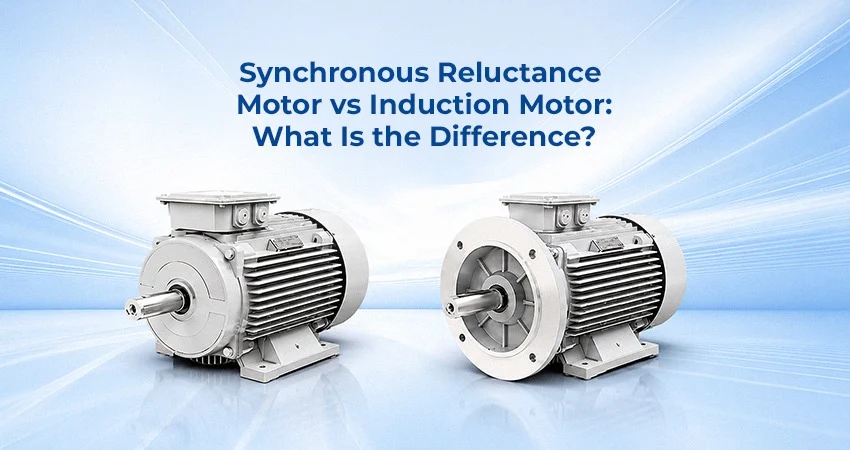
Slowing a centrifugal pump or fan makes a large difference to the power it draws. Because the power required rises with the cube of the speed, running at half speed needs about one-eighth of the full-speed power in an ideal system with no static head. For this reason, it is worth looking at how a motor is built and controlled, and not only at the rating on its nameplate.
Synchronous reluctance motors (SynRM) and induction motors both drive pumps, fans and compressors, but they create torque in different ways. A SynRM is typically operated with a variable frequency drive, an electronic controller that sets the motor’s speed. An induction motor, by contrast, can run straight from the supply.
How Does an Induction Motor Create Torque?
An induction motor has a stator, which is the fixed outer part, and a rotor, which is the part that turns. When alternating current flows through the stator windings, it creates a rotating magnetic field. This field cuts across the rotor and induces a current in it, and that current creates a second magnetic field. The two fields pull on each other, and the rotor starts to turn.
The rotor always runs slightly slower than the rotating magnetic field. This small difference in speed is called slip, and it is what keeps current flowing in the rotor. Because that current produces heat, some energy is lost in the rotor. Even so, this type is widely used because its construction is simple and rugged.
How Do Synchronous Reluctance Motors Work?
A SynRM has a stator similar to the one described above, but its rotor is very different. The rotor is made of stacked thin steel sheets, called laminations, with slots cut into them. These slots leave air gaps called flux barriers. The magnetic field passes easily through the steel but not through the air gaps, so the rotor has a preferred direction.
The rotor is aligned with the rotating field created by the stator, similar to the way a compass needle aligns itself with a magnet, and then it rotates at precisely the same speed as the field. This speed is known as the synchronous speed and, since the rotor never falls behind it under normal load, a SynRM has no slip.
A SynRM rotor has neither windings nor permanent magnets, so no current is induced in it. This is why the rotor stays much cooler than the rotor of an induction motor. This is the reason why the heat in the rotor is much less than for the induction type.
A SynRM is typically operated with a variable frequency drive. The drive controls the stator field so that the rotor stays locked to it.
How Much More Energy Efficient Is a SynRM?
The International Electrotechnical Commission (IEC) groups motors into efficiency classes from IE1 to IE5, and each higher class means lower energy losses. IEC 60034-30-1 sets the efficiency classes for motors that run directly from the supply, and IEC TS 60034-30-2 sets them for variable-speed motors that are designed to run on a drive.
Synchronous reluctance motors can reach IE4 and IE5, while the induction motors in LEDL’s range are in the IE2 and IE3 classes. A higher class means lower losses at the same rating, which is the starting point for any comparison. A SynRM is classed under IEC TS 60034-30-2 because it is designed to run on a drive, so a fair comparison looks at the motor and drive together against the induction motor.
The gain can be larger when a motor runs below full power, which is called partial load. Pumps and fans on a drive spend much of their day at partial load, so the saving can be bigger than the class label alone suggests.
Lower losses do not mean the electricity bill falls by the same percentage. The actual saving depends on the load, the running hours, the tariff and the drive, so it is best to compare the rated efficiency of the exact motors.
How Do the Two Motor Types Compare Side by Side?
Factor | SynRM | Induction motor |
Torque generation | Rotor aligns with the rotating magnetic field | Current induced in the rotor creates a second field |
Rotor construction | Laminated steel with air-gap slots (flux barriers), no windings or magnets | Conductive bars or windings that carry induced current |
Slip | None, the rotor turns at synchronous speed | Present, the rotor turns slightly slower than the field |
Drive requirement | Typically a variable frequency drive | Direct on line is possible, and a star-delta starter (which reduces starting current) or a drive can also be used |
Rare-earth magnets | None used | None used |
Rotor heat | Considerably lower | Some heat from induced current |
Efficiency classes in LEDL’s range | IE4 and IE5 | IE2 and IE3 |
Typical applications | Pumps, fans, blowers and compressors that run for long hours, often at variable speed | Pumps, fans, compressors, conveyors and general machinery, including fixed-speed duties started direct on line |
Is There a SynRM Equivalent to a 1 HP Induction Motor?
No. LEDL’s SynRM range starts at 3 HP (2.2 kW) and goes up to 120 HP (90 kW), so there is no SynRM at 1 HP. One HP is about 0.75 kW, which falls below the start of that range.
If you are replacing a 1 HP induction motor, a motor from the IE2 or IE3 induction range is the practical match. A SynRM becomes an option from 3 HP upwards.
Which Applications Suit Each Motor Type?
Synchronous reluctance motors suit machines that run for long hours, particularly pumps, fans, blowers and compressors. LEDL describes its IE5 motors as suited to pumps that run around the clock. With a drive they can follow the load, and LEDL’s IE5 page says the motor maintains high efficiency across speeds and varying loads, which suits variable-speed pumps and fans.
As an illustration, take a 22 kW water pump that has to run at about half speed for most of the day. In an ideal system with no static head, the power it needs at half speed is about one-eighth of the full-speed figure, which is around 2.75 kW (22 divided by 8), before motor and drive losses. At such a low load, how efficiently the motor runs at partial load matters as much as its full-load rating, and this is where a SynRM with a drive is most attractive.
The induction type remains a straightforward choice for fixed-speed machines that can start direct on line, and for general machinery where a drive is not otherwise needed.
LEDL’s Induction and SynRM Range
We manufacture both induction motors and synchronous reluctance motors. We have offered India’s first synchronous reluctance motor since 2016, in IE4 and IE5, and our SynRM range now runs from 3 HP (2.2 kW) to 120 HP (90 kW). Our three-phase motors run from 0.12 kW to 110 kW across two ISO 9001:2015 certified factories, with Coimbatore as our registered address.
If you are choosing an LEDL motor for a long-running pump or fan, the IE5 page and the shop list the available ratings, and you can contact our team for help in matching a motor to your duty.
FAQs
What is the difference between synchronous reluctance motors and induction motors?
A SynRM turns at the same speed as the rotating magnetic field, so it has no slip, and its rotor has no windings or magnets. In the induction type, the rotor runs slightly slower than the field, and a current induced in it creates the torque. Because of this, a SynRM loses far less energy in the rotor and works with a drive. The induction type can also run direct on line.
Is a SynRM more efficient than an induction motor?
Yes, in most comparisons. A SynRM can reach IE4 and IE5, while the induction motors in LEDL’s range are IE2 and IE3, which means lower losses at the same rating. The gap can be wider at partial load, and the actual saving depends on the model, the load and the running hours. It is best to compare the rated efficiency of the exact motors, and the LEDL energy audit page can help you estimate the savings.
Does a SynRM need a variable frequency drive?
Typically, yes. A SynRM is typically operated with a variable frequency drive, which controls the stator field so that the rotor stays locked to it. This is how the motor holds its synchronous speed.
Does a SynRM use rare-earth magnets?
No. A SynRM rotor has no magnets or windings, so it needs no rare-earth materials, which sets it apart from permanent magnet motors. An induction rotor does not use rare-earth magnets either, so both types differ from permanent magnet motors in this respect.
How do I choose an LEDL motor for my application?
Start with the load in kW and the number of hours the motor runs each day, then decide whether a drive will control its speed. Long-running pumps and fans with changing loads suit a SynRM with a drive, while fixed-speed machines may suit the induction type. LEDL’s SynRM range starts at 3 HP (2.2 kW), so smaller loads need an induction motor. Our team can help you check these details before you order.
Explore our latest Blogs
Best Electric Motor Manufacturers in Coimbatore for Industrial Use (2026 Guide)
Why High Efficiency Electric Motors Are the Smart Choice for Modern Industries
How IE5 Motors Help Industries Reduce Energy Consumption and Costs
How to Choose the Right Crusher Motor for Heavy-Duty Industries
Sources: Rotating electrical machines, Part 30-1: Efficiency classes of line operated AC motors, IEC 60034-30-1:2025, Edition 2.0 (IEC, 1 December 2025); Rotating electrical machines, Part 30-2: Efficiency classes of variable speed AC motors, IEC TS 60034-30-2:2016 (IEC, December 2016); Adjustable Speed Pumping Applications, Pumping Systems Tip Sheet #11 (U.S. Department of Energy, January 2007); LEDL About page; LEDL IE5 motors ; LEDL Energy Audit
