While thinking of electric motors, the picture of humming machines quickly appears in our minds. However, this steady humming sound is the sign that these motors are energy-efficient and deliver greater output by drawing less power. Whether you wish to power HVAC systems or water pumps, the secret behind this energy efficiency lies in the IES Synchronous Reluctance Motors (SynRM).
The transformative technology of SynRM is taking center stage in helping various industries strive to reduce their overall energy consumption and contribute to the global mission of net-zero emissions. The IE5 Synchronous Reluctance Motor is designed to deliver superior performance with minimal energy use, thus allowing businesses to meet their sustainability goals.
What is IE5?
The IE, or International Efficiency, is an international standard of classification system for motors. The IE5, also known as “Ultra Premium Efficiency”, refers to the highest efficiency class available to date.
It can be said that the IE5 SynRM motor is a highly energy-efficient variant when compared to its predecessors, the IE4 and IE3 motors.
So, if you are on a mission to save on your energy bills and lower your carbon footprint, switch to an IE5 electric motor.
How Does SynRM Technology Work?
Unlike traditional induction motors, the SynRM ones come with a special rotor design that has no magnets, no windings, and no earth elements. These systems reduce rotor losses, feature a longer motor lifespan, and reduce heat generation effectively.
The Energy Efficiency Movement
It is a global initiative that encourages governments, industries, and communities to work jointly towards building a sustainable future by making smart energy choices. We should focus on using technology and equipment that consumes less energy, generates less waste, and delivers high-quality performance.
The IEF SynRM motors offer ultra-efficient performance and meet overall operational requirements.
5 Things You Must Know About IE5 SynRM Electric Motors
Here are some interesting facts you should know about IE5 SynRM motors, and we will help you learn how they can align with your sustainable goals.
- They Created Their Own Efficiency Benchmark
Most motors we see today are measured against an international efficiency standard, which includes classes of IE1, IE2, IE3, IE4, and IE5. Each of these levels marks an improvement in efficiency over the previous level. IE5 SynRM electric motors are categorized among the highest efficiency class for motors because of their exceptional performance, setting the bar high for others. That means they produce less waste and deliver more usable power. Firms using these motors can lower their carbon footprint and save big on their electricity bills.
- They are Quieter and Cooler and Have Longer Lives
Traditional electric motors are prone to turning unusually hot frequently, and overheating shortens their lifespan. As a result, they demanded frequent servicing to keep them operational. However, the scenario changed with IE5 SynRM motors, as they are not dependent on rotor losses. As a result, there is less wear and tear, fewer servicing requirements, improved performance, and a longer lifespan. At the same time, operators don’t need to suffer from headaches induced by constant grinding noises because IE5 SynRM motors run relatively quietly.
- They Align Perfectly with Variable Speed Drives (VSDs)
Businesses can unlock the true potential of IE5 SynRM motors by pairing them with VSDs. The powerful duo can ensure precise control over the motor speed and torque, thus enabling appliances and equipment to use only the amount of energy that they need. That way, you don’t waste energy and meet your carbon footprint reduction goals. It is similar to using a dimmer that adjusts the brightness of a light bulb as and when required, enabling you to save power rather than leaving the bulb on all day.
- They Have Wider Applications
IE5 SynRM motors are more versatile than you can imagine. Their applications are spread across diverse industries, including pumps and fans, HVAC (heating, ventilation, and air conditioning), compressors, food and beverage processing, manufacturing and material handling systems, the paper and pulp industry, chemicals and pharmaceuticals, commercial building construction, etc. Irrespective of their applications, the IE5 SynRM motors offer the highest standards of efficiency and reliability compared to other motor classes like the IE4, the IE3, or the IE2 motor.
- They are a part of the energy efficiency movement.
With rising pressure from governments, communities, customers, and investors to minimize emissions, IE5 SynRM motors can align with these sustainability goals naturally. By lowering the energy wastage, these electric motors can contribute directly to reducing Scope 2 emissions. Furthermore, unlike traditional motors, the IE5 SynRM electric motors do not rely heavily on the rare earth elements. Therefore, they are less dependent on the limited natural resources of our planet, thus offering a more sustainable solution for generating power.
Why Choose LEDL for IE5 SynRM Electric Motors?
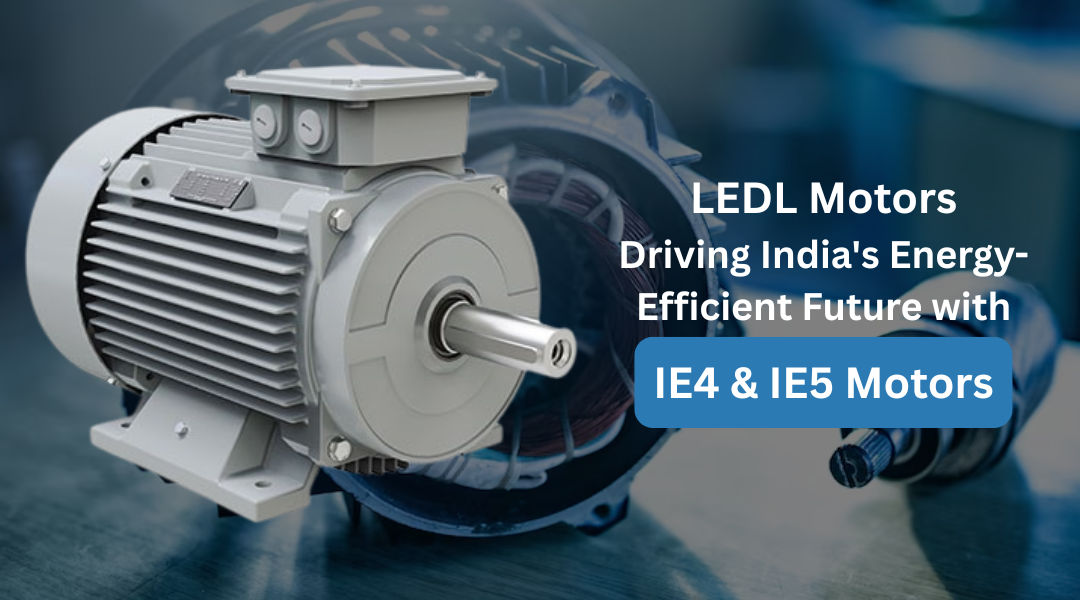
LEDL has pioneered India’s first Synchronous Reluctance Motor since 2016 in both IE4 and IE5 efficiency. At LEDL, we believe in helping industries use cleaner and greener energy-generating solutions. We provide a wide range of high-efficiency and cost-saving motors, including the advanced IE5 SynRM technology. It is designed to help businesses enjoy significant reductions in their energy bills while improving their performance and productivity simultaneously. LEDL’s ultra-efficient motors are designed to provide comprehensive support ranging from installation and servicing to retrofitting. We are committed to innovation, sustainability, and customer-centric solutions, while focusing on building a more sustainable future.
Key Takeaways
Electric motors may not be a very appealing component of today’s industrial scenario. However, without it, businesses could hardly survive. With the evolution of motors, the IE5 SynRM electric motors stand out for their innovative design and technology in boosting performance using the lowest energy possible, minimizing energy bills and energy wastage. As a result, it reduces downtime and maintains business continuity by requiring fewer repairs and replacements. So, with the right technology implementation, the steady humming sound of motors can be music to your ears rather than being a headache, both operationally and economically.