

How IE3 Motors Help Upgrading in Industrial Operations

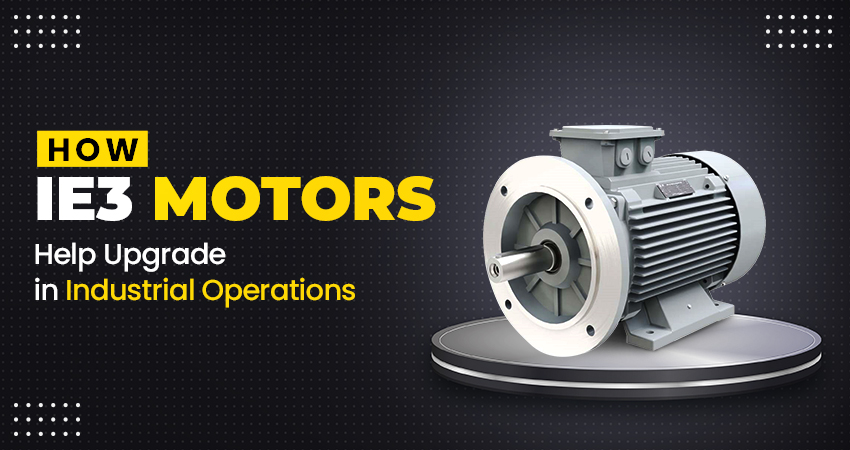
Industries demand saving every unit of energy to increase productivity at lower costs. This is why many industries are now adopting an IE3 motor. They are recognized for providing premium-efficiency and are designed to minimize energy losses, lower heat, and increase machine life. They are not just a way to replace existing designs; they improve how industries do business. The IE3 motors are rapidly becoming an essential piece of machinery in modernizing companies for the new economy as they try to avoid being left behind by changing market conditions, with respect to energy efficiency.
What Is An IE3 Motor?
IE3 is a class of efficiency for electric motors designated in the IEC 60034-30-1 standard. IE3 is also referred to as premium efficiency specifically for fixed speed, three-phase induction motors under continuous duty. Compared with older efficiency classes such as IE1 or IE2, the IE3 motor uses higher grade or quality materials and improved designs and tolerances that reduce losses from core, winding, friction and ventilation.
Why Choose An IE3 Motor?
There are many reasons why one should choose IE3 motors over other options. IE3 motors offer more energy efficiency at full load and at part load conditions as compared to other types of motors. Replacing the existing IE1 or IE2 motors with IE3 motors will establish efficiency gains to the tune of 5-8% for many operating load profiles. Over long operating hours and under continuous or near‐continuous duty applications, these savings translate into value.
There is a reduction in wasted heat that occurs with decreased electrical and magnetic losses. The lower the operating temperature, the better the insulation will perform, the cooler the bearings operate, and the slower the grease will degrade. All this turns into fewer breakdowns, less downtime, and reduced maintenance costs.
Additionally, IE3 motors are more effective in handling fluctuating voltages and high ambient temperature conditions or if there are modest overloads placed on them, which results in improved reliability and energy efficiency in extreme industrial conditions.
Many countries, and in particular Europe, are moving towards requiring IE3 efficiency for various ranges or series of motors. The IEC/IEC-60034-30 categorizes these, and a number of energy codes and standards require IE3 or higher efficiency for motors in various power sizes.
Economically, an industrial customer moving forward and changing to IE3 motor efficiency standards may benefit from lower policies if they are instituting energy audits, power tariffs, and regulatory and rule-based reductions in losses and energy usage. Being ahead of the requirements also provides a way to ensure a competitive edge and more energy efficiency.
Reductions in power consumed causes lower greenhouse gases emissions in regions where there is a reliance on fossil fuels for electricity generation. For companies pursuing sustainability efforts, ESG commitments, or focusing on decreasing its carbon footprint, IE3 motors become a larger piece of the tool kit. Less heat also means less need for cooling, thus bringing down the energy usage in many instances.
Optimizing IE3 Motor Usage
It’s not just about transitioning to IE3 motors, but utilizing them in the best way that allows users to gain full benefits, like energy efficiency. Industrial users should consider the following steps:
- Audit your motor fleet. Identify the motors that have the most run hours, run at high loads, or run continuously. These motors are generally where the greatest potential for energy savings exists because you can replace the older motors with a premium efficiency motor and reduce energy use by a significant amount, and it will add up quickly.
- Détermine the match of motor size to the load. Motors that are oversized and not running much more than lightly usually waste energy. An IE3 matched properly to the expected load is going to yield a better efficiency than a motor that is too big, or too small.
- Use variable frequency drives when applicable. For example, for loads that need to vary such as fans and pumps, when using an IE3 motor, you will see further savings when you incorporate a VFD. An IE3 motor will usually perform more efficiently under these conditional loads compared to older motors.
- Keep up the regular maintenance. Clean the bearings, verify that the cooling systems are functioning properly, keep up on insulation checks, and do not allow dirt or dust to accumulate. All general maintenance enables the IE3 motor to continue close to the rated performance level. Even premium efficiency motors will deteriorate in efficiency without maintenance.
- Assess the total cost of ownership of a motor, and not just the cost to purchase the motor. While IE3 motors are more expensive than the lower efficiency counterparts, throughout the operative life of the motor, it will payback in energy savings and reduced maintenance issues and durability.
- Plan for changing and developing environmental and regulatory trends. By making a decision to invest in high premium efficiency motors; operations can prepare for future energy code restrictions, potential on carbon charges to operations which may occur in the future, and as future energy audit requirements trend.
Discover LEDL’s Advanced Motores
As India’s leading motors manufacturers for industrial applications, especially the textile industry, we at Lakshmi Electrical Drives Limited (LEDL) provide you with high-quality, innovative, and sustainability-focused motors. Our motors are not just energy efficient, but also reliable. Bringing more than four decades of expertise and experience in electrical induction motors and synchronous reluctance motor production, we offer you cutting-edge solutions. As an ISO 9001:2015 certified organization, we emphasize quality and performance, ensuring industries can focus on their core functions without worrying about motor functionality or expenses due to long hours of operations. To know more about our cutting-edge products, connect with our representatives.
Conclusion
IE3 motors are an efficient solution to industrial applications, enabling businesses to achieve their sustainability goals effectively while also saving considerably on maintenance and usage bills. The modern motors are a significant improvement on older models, as they help minimize the amount of heat that is wasted which further helps minimize electrical as well as magnetic loss. Though initial investments might seem heavy, but the advanced performance of these motors, coupled with the range of advantages they offer means that it pays for itself in a short amount of time.