


Why UL Certified IE3 Motors Matter for Energy-Efficient Industrial Operations

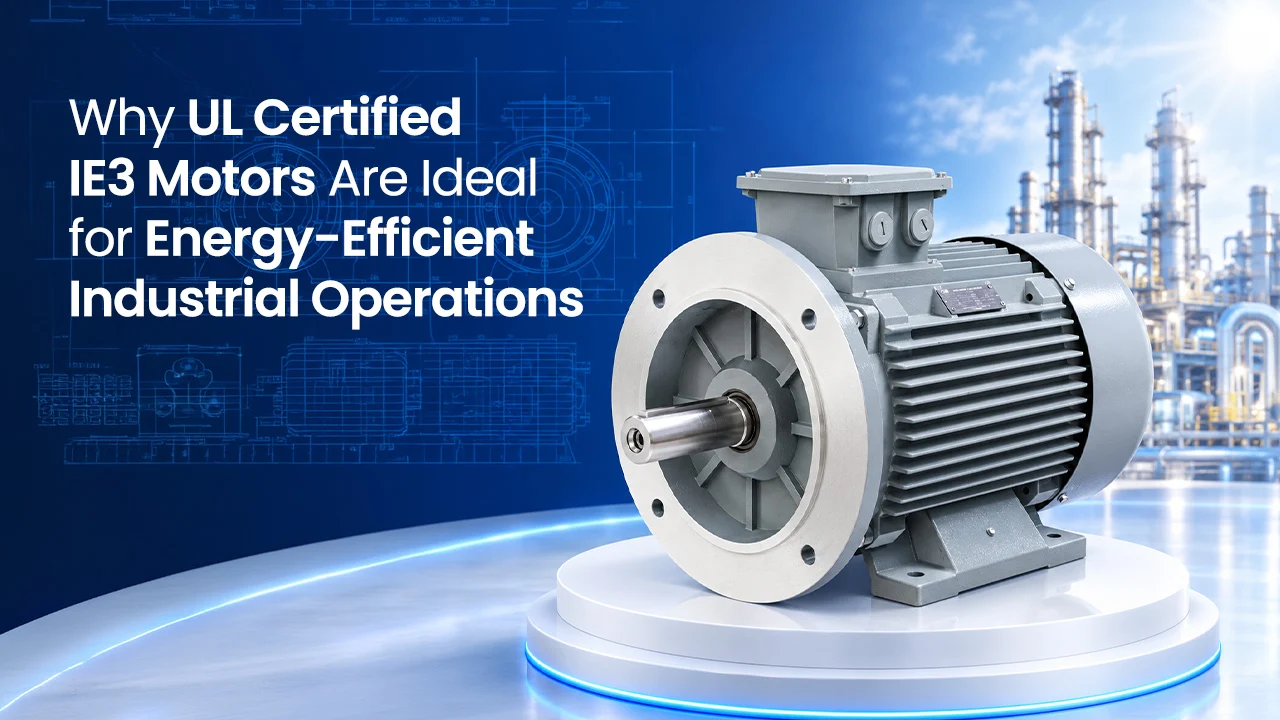
Choosing an industrial motor is not only about power and efficiency. If the equipment is being supplied to an international market, safety standards and certification can also affect which motor you can use.
This is where UL certified IE3 motors become relevant. They combine the IE3 efficiency class with UL certification for projects where both are required. Understanding what each one means can help OEMs and businesses make a more informed choice.
Understanding UL Certification in Industrial Motors
UL stands for Underwriters Laboratories, an independent organisation that provides testing and certification services for electrical products, including motors.
When a motor is UL certified, it has been evaluated against the UL requirements relevant to its certification. This provides buyers with documented information about the motor’s compliance.
The requirements are not the same for every motor. They can depend on the product, its application and the market where it will be used.
When UL Certification Becomes Important
UL certification is not something every industrial motor needs. It becomes important when a particular project, customer or market has certification requirements.
For example, an OEM supplying machinery to a market where UL certification is required may need to select a suitably certified motor. A customer may also specify UL certification as part of their equipment requirements.
Having the right certification in place can make the selection and approval process simpler, particularly for equipment being supplied to international markets.
Applications Where UL Certified Motors May Be Required
The need for UL certification depends on the project, but it can come up in situations such as:
- Equipment for export: Machinery being supplied to countries where UL certification is required
- Safety-focused applications: Equipment that needs to meet specific safety standards
- OEM machinery: Motors installed as part of larger equipment that requires certification
- Customer-specific projects: Projects where the customer specifically asks for UL-certified motors
Before selecting a motor, check the certification requirements for the equipment and the market where it will be supplied.
The Role of IE3 in Energy Efficiency
UL certification and IE3 refer to two different aspects of a motor.
IE3 is an efficiency class that indicates how efficiently a motor converts electrical energy into mechanical output under the applicable test conditions.
For equipment that operates for long hours, energy efficient IE3 motors can help reduce energy losses during operation. The actual energy savings will depend on factors such as the motor size, load, running hours and application.
So, if a project requires both IE3 efficiency and UL certification, the selected motor needs to meet both requirements.
UL Certification and IE3 Are Not the Same
It is easy to assume that UL certification and IE3 are linked, but they serve different purposes.
IE3: Relates to the motor’s energy efficiency.
UL certification: Relates to compliance with the relevant UL requirements.
An IE3 motor is not automatically UL certified. In the same way, UL certification does not determine the efficiency class of a motor.
For projects where both are required, it is important to confirm that the specific motor meets both requirements.
Things to Check Before Choosing an IE3 Motor
The efficiency rating is only one part of selecting the right motor. Before buying high efficiency industrial motors, OEMs should also look at:
- Certification: Check whether the specific motor model has the certification required for the project
- Documentation: Ask the manufacturer for relevant certificates and technical information
- Target market: Check the standards and certification requirements of the country where the equipment will be supplied
- Motor specifications: Make sure the motor’s power, speed and other specifications match the equipment
- Application: Consider the actual load, operating hours and working environment
Checking these details before placing an order can help avoid issues later, especially when the motor is being used in equipment for export.
Choosing LEDL for Industrial Motor Requirements
LEDL manufactures IE3 motors for industrial applications, including three-phase induction motors, along with motors in IE2, IE4 and IE5 efficiency classes.
Its motor range caters to applications across industries such as manufacturing, mining, textiles and HVAC. For projects where UL certification is required, buyers should confirm the certification and documentation available for the specific motor model.
This helps ensure the motor is selected based on the complete project requirement, including efficiency, power, application and certification.
FAQs
A UL certified motor has been evaluated against the UL requirements relevant to its certification.
Not necessarily. IE3 defines the motor’s efficiency class, while UL certification is a separate requirement.
No. It depends on the equipment, customer requirements and market where the motor will be used.
An OEM may need one when supplying equipment to a market or customer where UL certification is required.
Ask the manufacturer for certification details and confirm that they apply to the specific motor model.
